
Search Eugene Residents by Record
Eugene resident records work best when the first search matches the fact already known. A current street address belongs in Lane County’s free property tools. A deed date or party name belongs in the Deeds & Records index. A historic surname and year belongs with a library directory, newspaper, or archive collection. The County account may identify a parcel and tax mailing address, but it does not identify every person living there. Likewise, a recorded grantee may be an organization, trustee, former owner, or party to a transaction. Treat each result as a dated piece of evidence.
Use this Eugene residents directory workflow to make a small, checkable trail rather than a guess from one matching name. Keep the spelling used in the record, the date, and any account, map/taxlot, document, or case number. A property address that no longer matches a historic listing may reflect a unit change, a mailing-versus-situs difference, or an older street reference.
- For an address, use the free Lane property form or Easy Property Lookup and save the site address, account, and map/taxlot.
- For an ownership transfer, use the recorded-document party index and match the legal description.
- For personal registration, use Oregon My Vote only to check the voter’s own registration.
- For a court matter, save the court and case number, then use the correct court route.
- For an earlier household, ask Eugene Public Library for an actual directory or reverse-directory volume.
Note: A missing result can reflect the wrong custodian, date, spelling, access limit, or record type rather than proof that no record exists.
Eugene Resident Records Offices
Several Eugene offices sit close together, but their custody is different. Lane County Deeds & Records keeps recorded land instruments and the marriage-record route. Assessment & Taxation provides parcel and tax-account information. Lane County Elections administers local election records and voter-list requests. The City Recorder keeps City records, but the City expressly says it is not custodian of County deeds, marriages, vital certificates, Sheriff reports, or Circuit Court files. Starting with the right office saves an unnecessary request and preserves the distinction between a City file and a County record.
Lane Assessment & Taxation
County parcel and tax records
Eugene, OR
County property route
The City’s public-records route accepts JustFOIA, PDF, email, and mail requests. Under ORS 192.324, a public body generally must acknowledge, complete, or state custody within five business days. A focused request with an address, date range, permit number, or document number is more useful than an open-ended request.
Eugene Parcel Clues by Address
For a present Eugene address, the free Lane County Assessment & Taxation form is a narrow but useful start. It accepts one mode at a time: Account Number, Site Address, or Map & Taxlot. The basic form does not include owner-name search. That limit matters because an owner-name result available through subscription RLID Standard Search should not be promised to a visitor using the free County form. Assessment data are updated weekly, and the results link tax statements and tax maps.
Lane County’s basic property search shows the three free entry routes used to turn an Eugene street address into a parcel record.
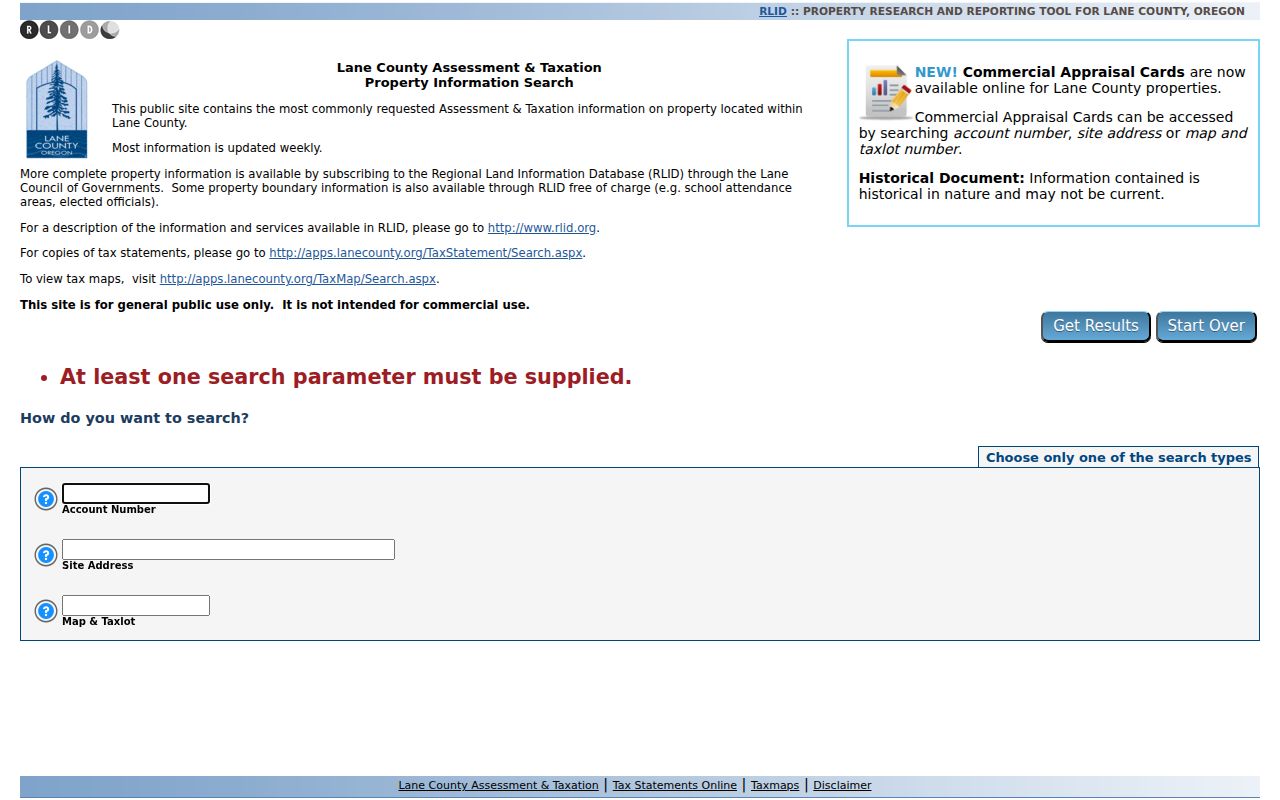
After an Eugene result opens, preserve labels exactly as shown. A situs address is the parcel’s physical location; a tax mailing address is where tax correspondence goes and may belong to an agent, trust, organization, or another property.
| Lane form field | Entry type | What it anchors |
|---|---|---|
| Account Number | Text | A County tax account |
| Site Address | Text | The physical parcel location |
| Map & Taxlot | Composite text | The parcel identifier |
Eugene Recorded Document Trail
RLID is the paid Lane County research environment for a deeper Eugene property and recorded-document trail. Its documented property modes include site address, map/taxlot, tax account, owner name, business name, and subdivision. Its deed search uses grantor or grantee name, instrument number, instrument type and year, and map/taxlot when assigned. RLID updates its index nightly. Scanned document images are typically available from 1994 forward, so an older title question often has to move to the County research library rather than stop at an absent PDF.
RLID Property Search introduces its Standard, Advanced, and map-search paths, including the login boundary for underlying searches.
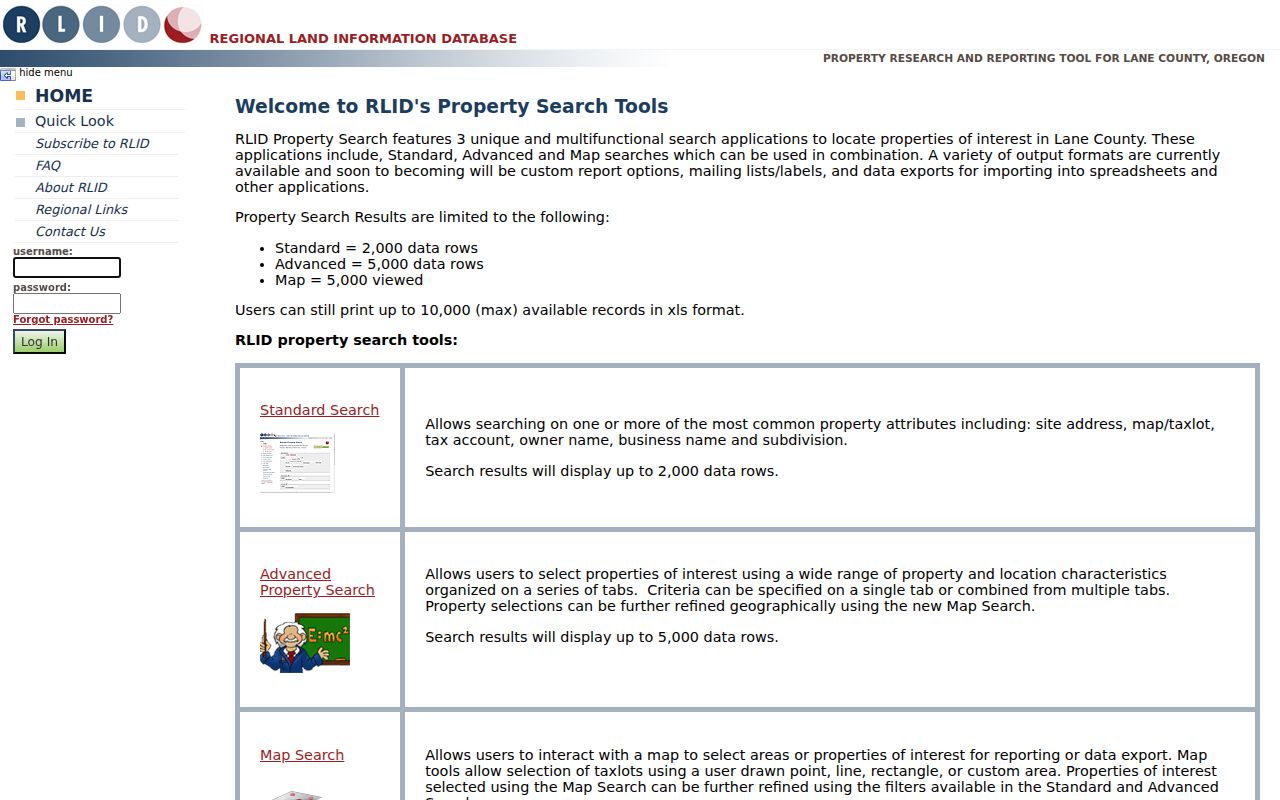
The reliable Eugene sequence is address to parcel, current owner as grantee, recorded acquisition document, then prior seller as grantee. Match the legal description at every turn. A party-name match alone is not enough when an address has changed, been subdivided, or is associated with a trust or business.
- Parcel
- A defined property unit identified in the County assessment system.
- Map & taxlot
- The County identifier that connects a site to tax maps and records.
- Grantor and grantee
- The recorded transferor and recipient named in a document.
- Criss-cross directory
- A historical volume that may run from street number to a listing in that edition.
Note: Lane County’s public research library can help with books, microfilm, and older index eras when online image access ends.
Eugene Resident Directory Sources Today
Current Eugene resident-directory clues are spread across different official systems. Property accounts identify a parcel and ownership-related trail. Recorded instruments identify transaction parties. Court results identify parties in public cases. A permit can identify a public project relationship. None of those sources is a complete household list, and each needs a date and access caution. The most useful source depends on whether the question is about a parcel, a transaction, a court file, or a civic record.
| Eugene source | What it may establish | Custodian | Access route |
|---|---|---|---|
| Property account | Site, account, parcel, ownership-related references | Lane Assessment & Taxation | Free address/account/map-taxlot form |
| Recorded instruments | Transaction parties, type, date, legal description | Deeds & Records | RLID and research library |
| Voter registration | Personal registration status | Oregon elections | My Vote self-service |
| Public case record | Public case party, events, disposition | Oregon Judicial Department | Free search, terminal, or request |
| Permit record | Addressed project and public application relationship | Eugene PDD | Permit search or request |
An Oregon Secretary of State business filing can help explain an entity, agent, or mailing address connected to a record. It cannot establish that an individual lives at that address. For a person-specific cross-check, the Eugene resident lookup route organizes records by name, date, and custodian.
Eugene Voter Records and Limits
Oregon My Vote is for a voter to check registration, update registration, check ballot status, locate an elections office, and find a ballot drop site. Its documented self-service path uses the voter’s name and date of birth. It is not an anonymous Eugene street browser. A name change uses a paper card because a new signature is needed. Lane County Elections administers voter registration and local requests, while statewide rules determine which elector fields can be inspected or delivered in a list.
Oregon My Vote is the official self-service entry point for an Eugene voter’s own registration and ballot functions.
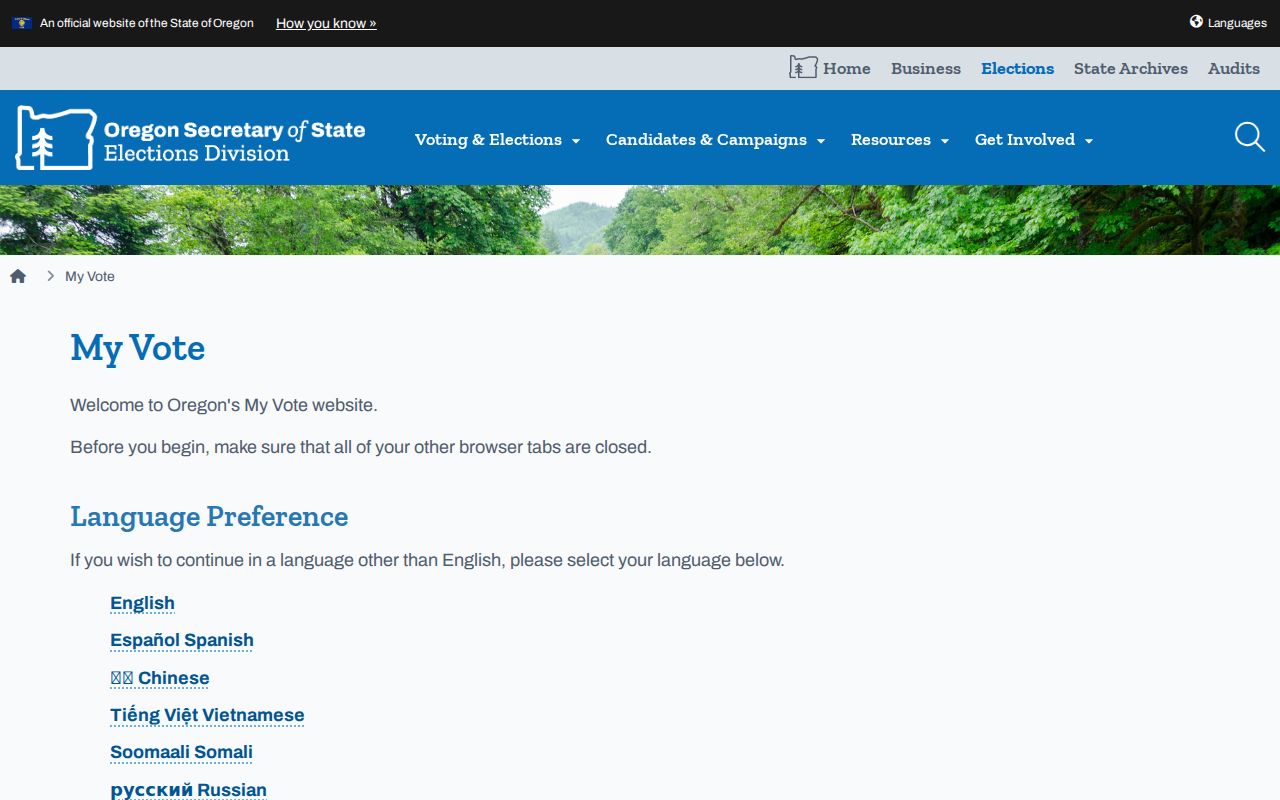
A lawful voter-list request follows ORS 247.945 and the Secretary of State process. Public fields have exclusions: protected and ACP records, birth month and day, identification numbers, signatures, and ballot choices are not public. A no-match is not a conclusion about where a person lives.
Eugene Court Records for Names
Court records can distinguish people who share a name when a public case identifies a court, case number, party role, dates, events, or disposition. Eugene Municipal Court has its own City-court search for basic docket information. Lane County Circuit Court records belong in the Oregon Judicial Department system, not in a County deed search or a City Recorder request. OJD’s free service is limited to public basic information. OJCIN is the registered paid route, while each circuit court has a free public terminal for most nonprotected cases.
OJD Records and Calendar Search links the free Circuit and Tax Court search, calendars, and related court search modes.
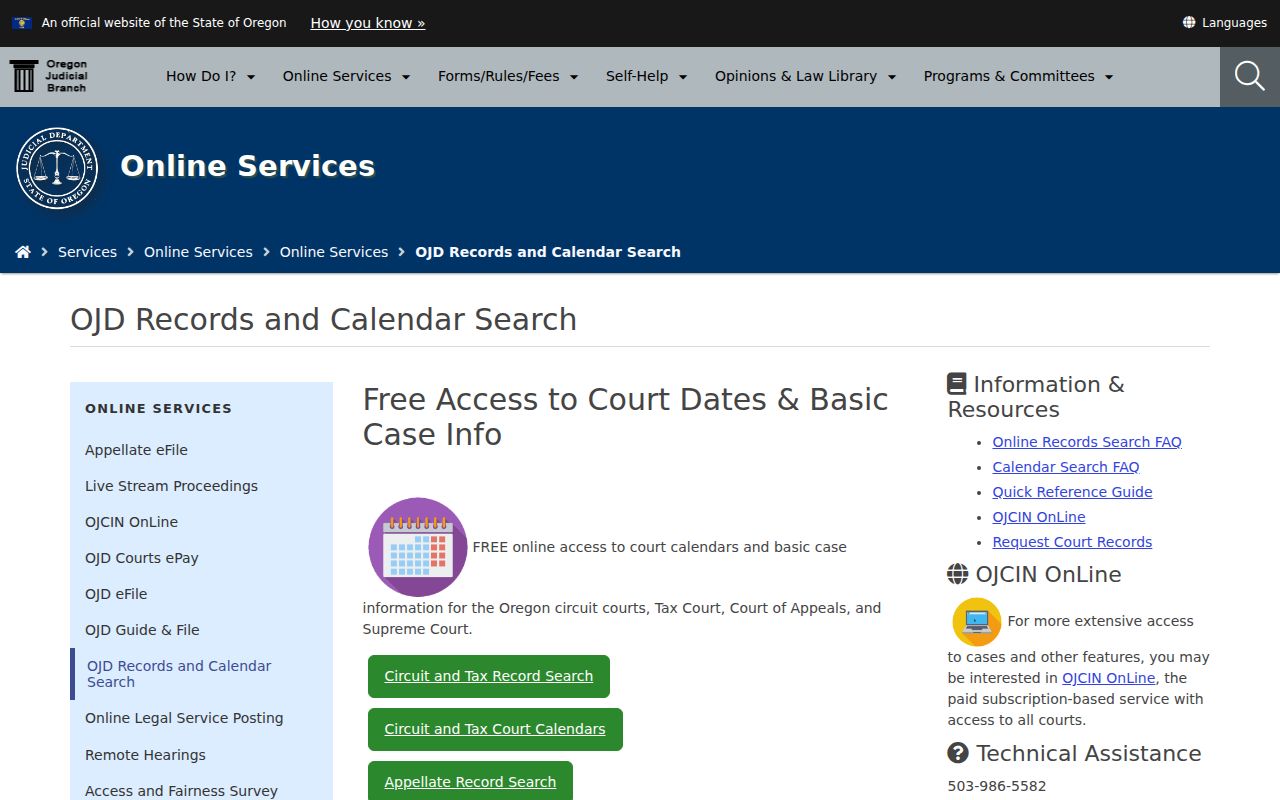
Free public results can include basic case information, first and last party names, event entries, dates, and disposition. Adoption, juvenile, mental-health, VAWA-related, sealed, and other protected records are excluded or restricted. Obtain an eligible official or certified copy from the court that holds the file.
Note: A shared name is a lead, not identity proof, until separate public records agree on the relevant time, jurisdiction, and record details.
Eugene Permits by Address
Eugene Building & Permit Services offers an address-first layer that can be searched by permit number, address, map and tax lot number, person or business, and contractor name. A result may identify a project, applicant or contractor association, event dates, inspections, and compliance documents where displayed. It does not prove that a named applicant owns or lives at the site. Read the address, map/taxlot, date, type, and status as separate fields.
Eugene’s permit search is the official starting point for a public permit or inspection trail tied to an address.
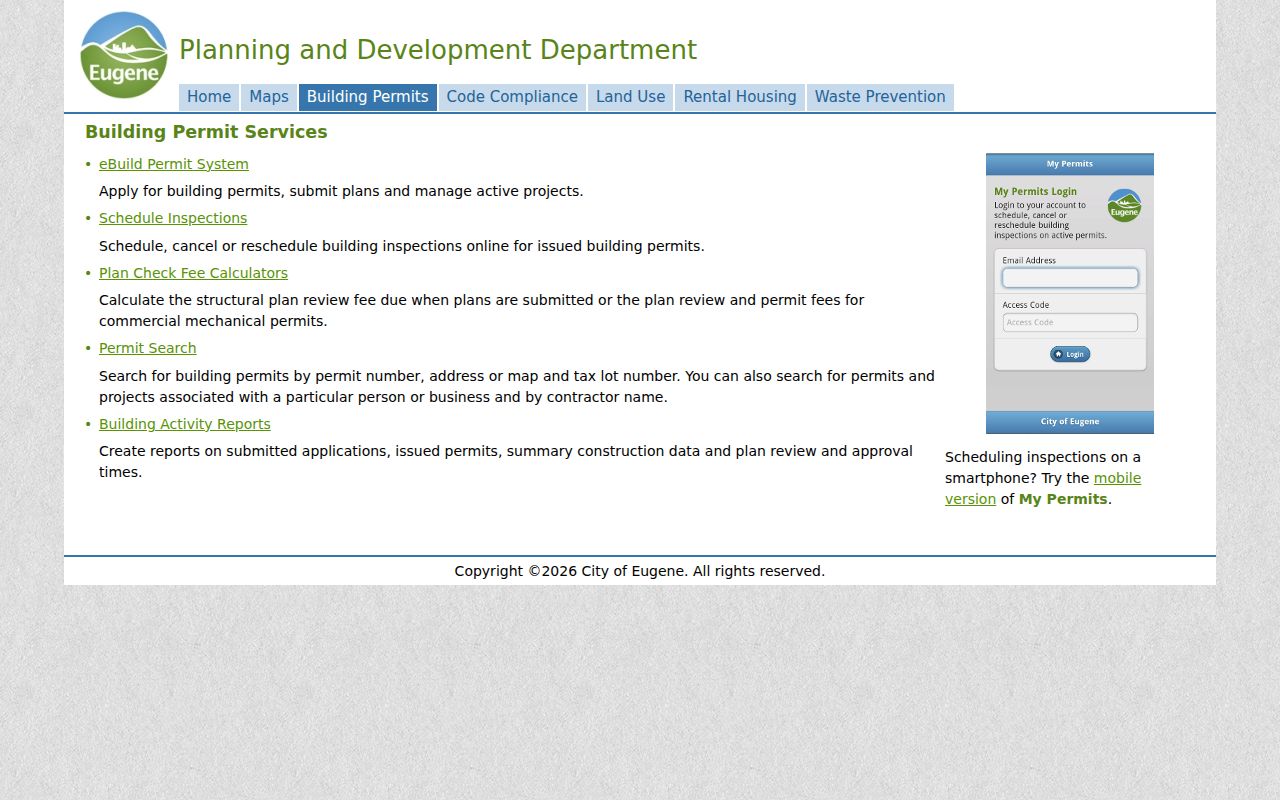
Online permit, inspection, and certificate records run from June 1998 to current. Pre-June 1998 material requires a tailored Building & Permits public-records request for each address, with an estimate of up to 10 business days and possible fees. In 2025, City reporting counted 6,935 permit applications, so one Eugene address can have several related records.
Eugene Historical Directory Sources
Historical Eugene directories need a volume-by-volume approach. Eugene Public Library is the local starting point for cataloged directories, telephone books, newspaper databases, and reference help. Official sources verify the Polk’s Eugene and Lane County directory title family, but they do not publish a dependable complete shelf-by-year run. Ask reference staff for a catalog and shelf pull using Eugene directories, Eugene-Springfield city directory, telephone directory, criss-cross, or reverse directory. Then inspect the title and abbreviation pages before describing what a volume contains.
A directory entry may show a name, relation notation, occupation, employer, home or business address, telephone number, and renter or owner mark, but editions differ. A reverse volume, when held, runs from a street number to listings in that edition. It is a historic publication, not today’s property roll. The full shelf and volume-inspection method belongs with the Eugene city directories.
For a household trail, move a year forward and back, compare a contemporaneous census when released, and then check deed, permit, obituary, or probate evidence. An absence from one publication is only an absence from that publication.
Eugene Archive and Library Routes
When an Eugene online record stops, local research channels remain. The Lane County History Museum holds more than 300,000 local photographs from the 1860s to the present, plus family, business, school, civic, map, and clipping materials. Its archive is closed-stack: submit a research request or email the staff, then arrange an appointment or copying if the item is available. Eugene Public Library’s Info Hub offers research products at its computers without a card and remotely for many cardholders. University of Oregon Special Collections adds yearbooks, alumni publications, photographs, and permanent university records.
Eugene Public Library Info Hub is a practical place to ask for the current licensed genealogy and newspaper resources or a directory call number.
For County land records, the Oregon State Archives’ Lane inventory maps older deed books, grantor and grantee indexes, probate, maps, and naturalization records to their repositories. It is a locator, not a substitute for the original record. Take document, volume, legal-description, or name details to the library, archive, or County research desk.
Eugene Business Record Connections
A public business filing sometimes clarifies the entity behind an Eugene property or permit record. The Oregon Secretary of State search accepts Business Name or Business Registry Number and offers Search and Advanced Search. Active public results can show the registry number, entity type, registry date, registered agent name and address, business mailing address, and associated names. Those fields describe a filing. They do not show a person’s home or current location, and the business registry is not a professional-license verification.
Oregon Business Name Search provides the State’s official business-name and registry-number entry route.
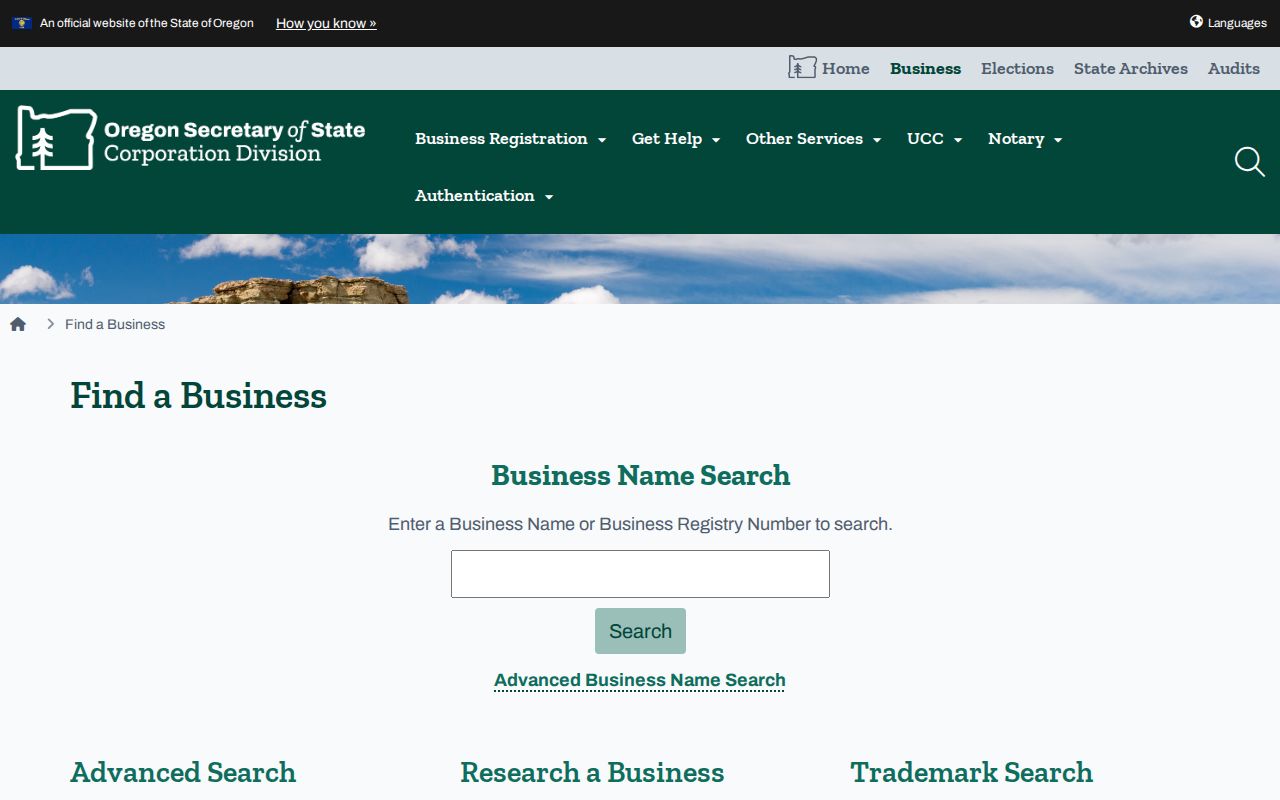
For an active filing, record the entity name, registry number, date, and the label on each address before comparing it with a deed or permit. If a license question remains, use the controlling Oregon board because business registration and licensing are separate records.
Eugene Custody Record Boundaries
Custody information is not an address directory. Lane County’s AIC Viewer is for current custody only, while Oregon VISOR provides a state safety and custody-status search by full name, partial name, State ID, or County ID. It can also provide confidential notifications after opt-in. A County or State custody result does not establish a current home address, and an absent Lane result does not answer every Oregon or federal custody question.
Oregon VISOR shows the official full-name, partial-name, SID, and County-ID search options for custody-status information.
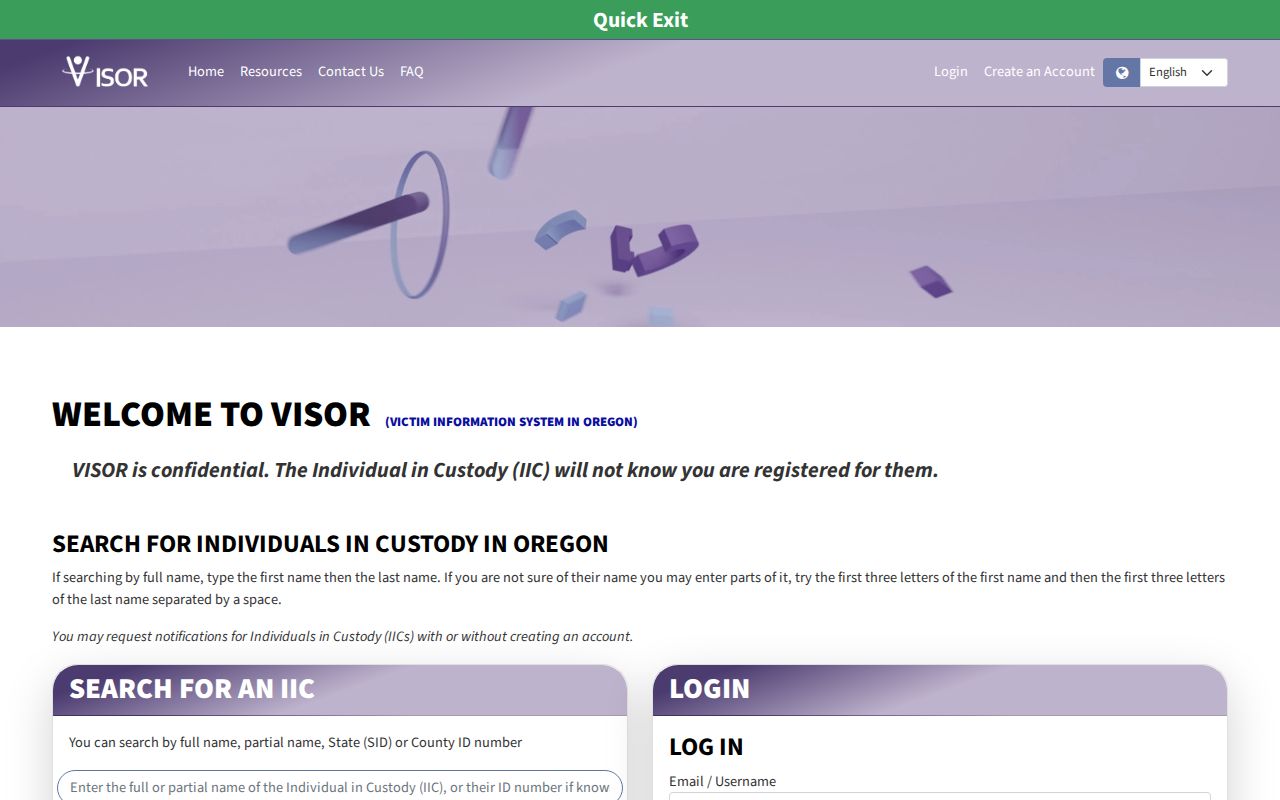
Use the original custodian for a lawful record request or safety notification. Do not rely on a result alone for safety or use it to attempt unwanted contact.
Eugene Resident Record Boundaries
Some Eugene records are open only through a defined request channel, and others are not open at all. Oregon vital certificates have 100-year birth and 50-year limits for other listed record types under ORS 432.380. Protected voter and Address Confidentiality Program records are excluded from voter lists. OJD excludes protected court records. DMV and utility customer data are not a public household directory. These limits are not gaps to work around by combining sources.
| Official Eugene record | Compiled people-search category |
|---|---|
| Names the agency, record type, date, and access limit; a reader can ask the custodian about an error. | Can merge public and commercial data, carry stale addresses, or confuse people with the same name. |
| Supports a narrow fact such as a parcel, recorded party, public case, or permit relationship. | Cannot replace the original office record or override a confidentiality protection. |
When a portal has no answer, use the documented fallback: Deeds & Records’ public research library or copy request, an OJD terminal or court request, a focused City or County public-records request, or a library and archive inquiry. The Oregon Public Records Law permits agencies to charge actual reasonable search, duplication, and review costs, and an estimate is required before a charge over $25. The correct end point may still be no public access.
Note: A record with a valid number or official-looking field can still be outdated, incomplete, or attached to a different person with the same name.