
Eugene City Directory Collections at a Glance
Eugene Public Library is the first local stop for city directories, telephone books, obituary help, and general genealogy research. The verified local title family includes Polk's Eugene and Lane County directories, but public institutional sources do not publish a complete, dependable shelf list of every Eugene year. That is a meaningful limit. Ask the library to confirm a title, volume, year, branch, call number, and whether an alphabetical or reverse section is actually present before using it as evidence. The following channels describe known coverage, not a promise of an unbroken city-directory run.
| Collection | Years | Where Held | Access |
|---|---|---|---|
| Eugene city-directory title family, including Polk | Title family verified; exact local holdings years are not published | Eugene Public Library catalog and reference service | Request a shelf or call-number pull; inspect the individual volume. |
| Lane County History Museum archive | Settlement and growth since 1847; photographs from the 1860s to present | Lane County History Museum Research Library and Archives | Closed-stack research request, then an appointment or reproduction path. |
| UO Special Collections and University Archives | Permanent university records from 1872; Old Oregon, 1919-93 | Knight Library and UO digital collections | Search finding aids and request material before a visit. |
| Historic Oregon Newspapers | 1846-2024 statewide database | University of Oregon online collection | Keyword search by newspaper title, date, and name variant. |
| Eugene Sanborn map sources | 1902 at Library of Congress; 1925-1949 in Museum inventory | Library of Congress online and LCHM by request | Map context for a block or structure, not resident names. |
Use the library catalog terms “Eugene (Or.)--Directories,” “Eugene-Springfield city directory,” “Polk's Eugene and Lane County directory,” “telephone directory,” “criss-cross,” and “reverse directory.” A catalog result identifies a possible volume. The title page still decides its publisher, date, geographic scope, and access rules.
Note: A missing year in an online catalog view is not proof that no local volume, microfilm copy, or staff-assisted source exists.
Finding Verified Eugene City Directory Volumes
The Eugene Public Library Info Hub is the practical route when a web search does not reveal the edition needed. Most subscription resources work remotely with a Eugene library card or on Info Hub computers without a card. Reference staff can help locate the catalog record, identify the current licensed newspaper or genealogy resource, and direct a visitor to an appropriate shelf or reference volume. The City's library hours and locations page identifies the Downtown, Bethel, and Sheldon branches, while the official library catalog is the place to preserve a permalink or call number once a title is found.
The Info Hub research page shows the library's entry point for on-site database access and reference-oriented searching.

The screen is a useful reminder that a library database landing page is not a published inventory of directory years. Ask for the exact Eugene volume, then record what the actual item says.
How a Eugene Directory Entry Reads
A historical directory is only as clear as the edition in hand. Start with its title page, contents, coverage statement, and abbreviation key. Then transcribe the visible listing rather than filling gaps with assumptions. One volume may show a head of household, occupation, employer, home address, business address, telephone number, or relation notation. Another may show far less. The same caution applies to an owner or renter mark, if the particular volume has one.
| Entry heading | Exact surname, given-name form, initials, suffixes, and cross-reference wording. |
|---|---|
| Household notation | A spouse, widow, or relation notation only when the inspected edition prints one. |
| Work detail | Occupation, employer, business, or business address when displayed in that listing. |
| Address detail | Home street number and street spelling, plus a separate business address if one appears. |
| Edition clues | Renter or owner marker, telephone, and abbreviations only when the title's key explains them. |
- Criss-cross directory
- A reverse listing that may move from a street number to a person or business in that particular volume. It is not a current property roll.
- Householder index
- An alphabetical arrangement of the people a volume chooses to list, often useful for locating an address before checking a reverse section.
- Abbreviation key
- The edition's own explanation of shortened labels and symbols. Photograph or transcribe it before interpreting a mark in an entry.
Eugene Directory Research Beyond Listings
When a directory entry leaves an unanswered question, Eugene has several local history channels. The Lane County History Museum Research Library and Archives holds family, business, school, and civic-organization manuscripts, maps, books, reports, clipping files, and more than 300,000 local photographs. Its collection is closed-stack. Submit a research request or email research@lchm.org, then staff may arrange an appointment, a scan, or a photocopy. The published policy lists photocopying at 50 cents per page, while higher costs or a denied request remain possible.
The Museum's research and photo service explains the staff-assisted archive route for older Eugene directory questions.
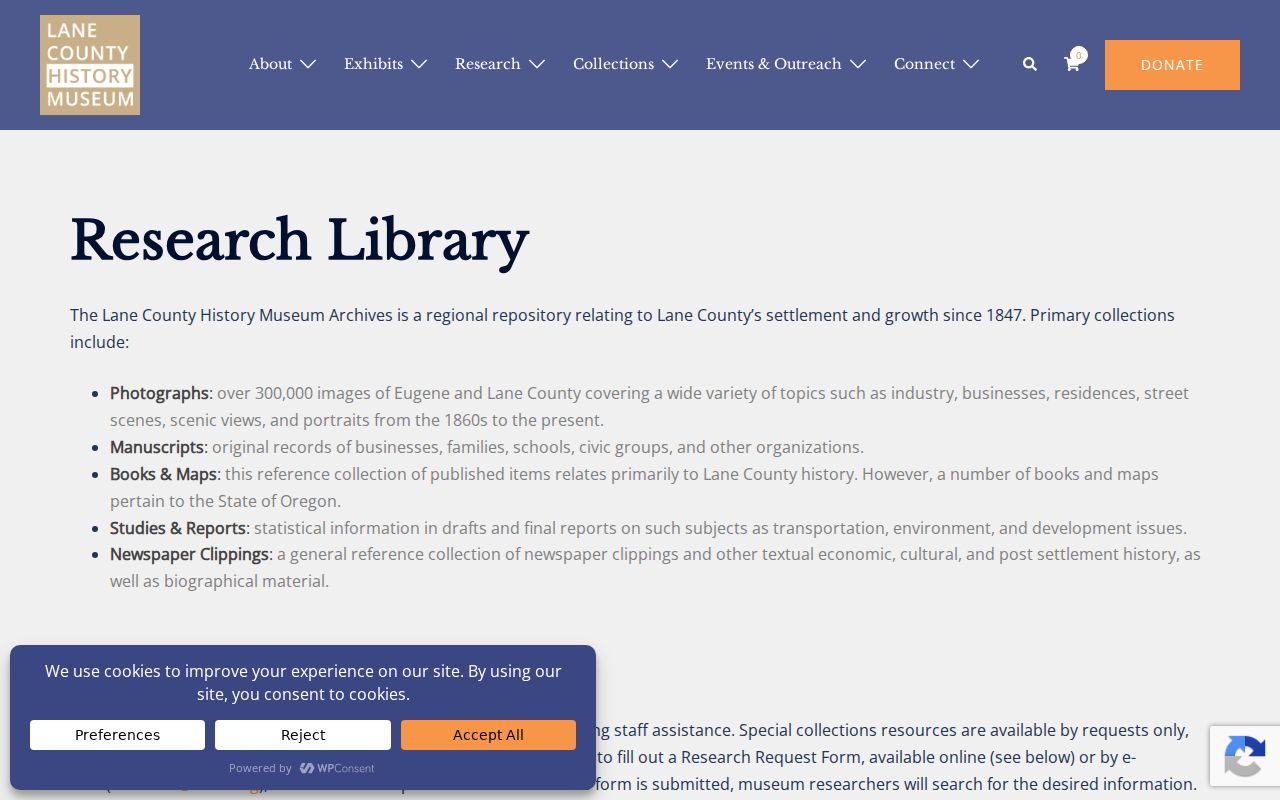
Include a surname variant, street or intersection, approximate period, and the desired source type in a request. That helps staff distinguish a photo, clipping, map, school record, or civic-group lead.
University of Oregon Special Collections and University Archives adds digitized yearbooks, alumni material, photographs, personal papers, and university records. Request physical material at least five business days before visiting. These are dated community sources, not a comprehensive Eugene resident roll.
Note: The museum has no guaranteed research turnaround, so a confirmed catalog or archive request should be saved with the search notes.
Tracing a Eugene City Directory Household
Use a confirmed volume to build a household timeline one edition at a time. Begin near the suspected year, preserve the printed name and street wording, and move forward and backward only through volumes the library verifies. A listing's absence means absence from that publication. It does not establish that a person left Eugene, died, or was never present. Pair city directories with other dated sources so a similar name or a changed address is not mistaken for the same household.
- Find an alphabetical entry in a verified year and record the edition title, surname form, address, and every visible field.
- Check the next confirmed earlier and later volumes for spelling changes, moves, work detail, or a revised household notation.
- Open a reverse or criss-cross section only if that volume actually contains one, then compare its street-number entry with the alphabetical listing.
- Pair the directory date with the relevant federal census release, a deed or tax-account trail, and a newspaper or obituary lead.
- Keep conflicting address forms side by side until maps, plats, tax lots, or City addressing records clarify the connection.
The historical volumes give a past household clue, while a modern street or parcel question calls for current address records. A census can provide a household snapshot, but federal census releases follow a 72-year access schedule. The National Archives census guidance is the proper place to confirm which year is publicly available.
Eugene Maps Beside Historical Directories
A directory address gains context from a map, not a resident name. The Library of Congress Eugene Sanborn item provides a digitized 1902 fire-insurance map, and the State Archives Lane County inventory identifies Museum-held Eugene insurance maps for 1925 through 1949. These sources can show a structure, use, or block arrangement at the map's date. They cannot identify who lived there.
For a stubborn old street number, preserve the original address before translating it. Eugene's Survey Location Books retain historic street and alley centerline locations, and later centerline references are filed with the Lane County Surveyor. A map, plat, or legal description can therefore test an address change without pretending that a modern street number appears unchanged in every city directory.
Eugene Newspaper Routes for Directory Dates
Historic Oregon Newspapers is a University of Oregon keyword-searchable collection with more than 2.3 million pages dated 1846 through 2024. Search a name variation with a street, employer, school, or organization, then retain the publication title, issue date, page, and image reference. Newspaper evidence can help date a move, business, civic role, or obituary notice alongside a directory listing.
The collection's own Register-Guard FAQ draws an important boundary: it does not contain a complete Eugene Register-Guard run. The FAQ directs researchers to a separate past-issues route for Eugene Register-Guard material. Verify the title-specific coverage and cite the exact issue, rather than implying that one newspaper search spans every Eugene publication year.
Note: A newspaper mention is a dated clue, not a replacement for inspecting the directory edition or the original record it suggests.
Limits of Eugene Directory Evidence
It is a myth that a city directory automatically names every person at an address. Directory publishers chose what to print, and a reverse listing may omit unlisted people or use an address form that no longer matches current maps. A directory listing can support a historical lead, but it should be checked against a census, deed, tax account, permit file, obituary, probate record, or another independent dated source.
Eugene City Recorder public records are also a different category. The City's route covers City legislative, contract, land-use, and historic municipal material, but the City expressly says it is not custodian for county deeds, marriages, vital certificates, sheriff reports, or circuit-court files. Direct a request to the custodian that actually holds the record and phrase it with a date, address, record number, or subject.
For a City-held historic document, the published route is JustFOIA or a PDF form sent by email or mail to the City Recorder. Identify the relevant time range, address, permit number, or subject. The City warns that an unrestricted request for every record can require substantial search and review time. Under Oregon Public Records Law, the City must acknowledge or complete a written request, or state whether it is custodian, within five business days.